
Description
First book-length archaeological study of a nonelite white population on a Caribbean plantation
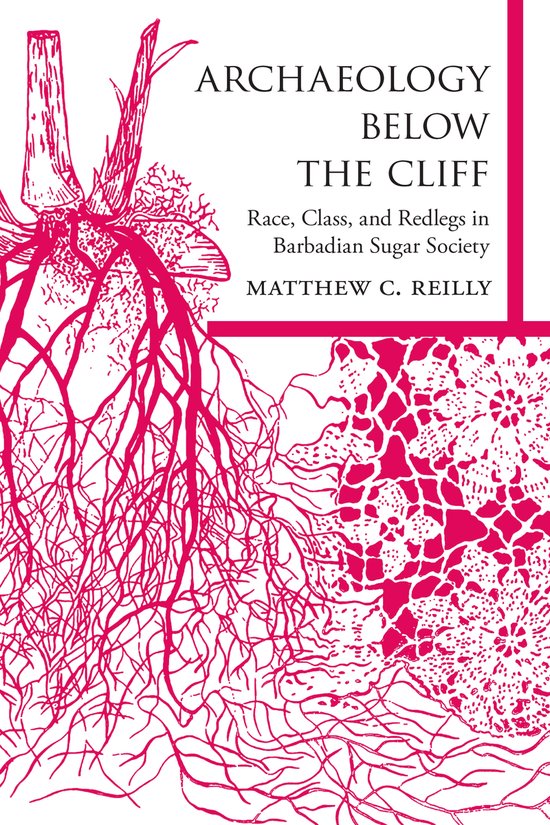
Archaeology below the Cliff: Race, Class, and Redlegs in Barbadian Sugar Society is the first archaeological study of the poor whites of Barbados, the descendants of seventeenth-century European indentured servants and small farmers. “Redlegs” is a pejorative to describe the marginalized group who remained after the island transitioned to a sugar monoculture economy dependent on the labor of enslaved Africans. A sizable portion of the “white” minority, the Redlegs largely existed on the peripheries of the plantation landscape in an area called “Below Cliff,” which was deemed unsuitable for profitable agricultural production. Just as the land on which they resided was cast as marginal, so too have the poor whites historically and contemporarily been derided as peripheral and isolated as well as idle, alcoholic, degenerate, inbred, and irrelevant to a functional island society and economy.
Using archaeological, historical, and oral sources, Matthew C. Reilly shows how the precarious existence of the Barbadian Redlegs challenged elite hypercapitalistic notions of economics, race, and class as they were developing in colonial society. Experiencing pronounced economic hardship, similar to that of the enslaved, albeit under very different circumstances, Barbadian Redlegs developed strategies to live in a harsh environment. Reilly’s investigations reveal that what developed in Below Cliff was a moral economy, based on community needs rather than free-market prices.
Reilly extensively excavated households from the tenantry area on the boundaries of the Clifton Hall Plantation, which was abandoned in the 1960s, to explore the daily lives of poor white tenants and investigate their relationships with island economic processes and networks. Despite misconceptions of strict racial isolation, evidence also highlights the importance of poor white encounters and relationships with Afro-Barbadians. Historical data are also incorporated to address how an underrepresented demographic experienced the plantation landscape. Ultimately, Reilly’s narrative situates the Redlegs within island history, privileging inclusion and embeddedness over exclusion and isolation.
LangueenVersionlivre numériqueDate de sortie initiale03 septembre 2019Format ebookAdobe ePubIllustrationsNon
Personnes impliquées
Auteur principal
Matthew C. Reilly
Editeur principal
University Alabama Press
Options de lecture
Lisez cet ebook surLecteur électronique KoboiOS (smartphone et tablette)Ordinateur de bureau (Mac et Windows)Android (smartphone et tablette)Windows (smartphone et tablette)
Informations sur le fabricant
Informations sur le fabricantLes informations du fabricant ne sont actuellement pas disponibles
Autres spécifications
Livre d‘étudeNon
EAN
EAN9780817392420
Sécurité des produits
Opérateur économique responsable dans l’UE
Afficher les données
Vous trouverez cet article :
Catégories
Hommes et société
Histoire
Archéologie
Questions sociales et éthiques
Régions et pays
Amérique du nord, centrale et sud
Livres
Livre, ebook ou livre audio ?
Ebook
Disponibilité
Disponible à l’adresse suivante
Langue
Anglais
Pays
Barbade





Avis
Il n’y a pas encore d’avis.