
Description
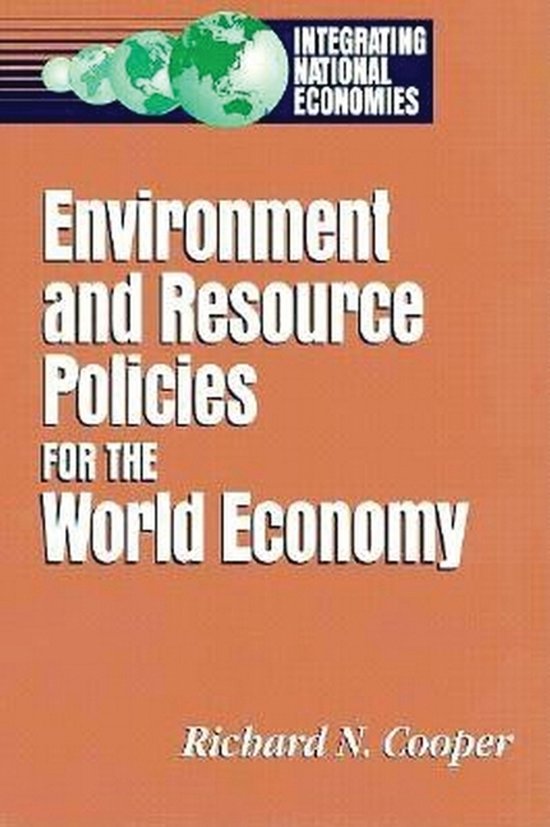
Evaluates the need for international policy action in natural resource and environmental management. Using numerous examples, Richard N. Cooper illustrates the issues that cause conflict in environment and resources policies. Cooper divides the use of natural resources into three categories and examines the rationale for international action in each.
To whom do the Earth’s riches belongall of mankind, the nations in which those riches are found, or individuals? Why should a relatively small number of Arabs own most of the world’s oil reserves? Why should South Africans own most of the world’s gold and diamond resources? Or why should the Americans and Canadians own the agriculturally rich Great Plains? Shouldn’t these resources and the environment be treated as endowments available to all mankind?Long ago, the international community agreed to a system of national ownership of natural resources, giving states sovereignty over their respective territories. In recent years, however, environmentalists have raised questions about this distribution of property rights with respect to global environmental issues, such as atmospheric disposal of waste gases, preservation of the Earth’s genetic material, and the destruction of tropical rain forests. When environmental impacts are global, international action may be warranted to ensure that individual nations are complying with transnational standards.In this book, part of the Brookings Integrating National Economies series, Richard N. Cooper evaluates the need for international policy action in natural resource and environmental management. Using numerous examples, he illustrates the issues that cause conflict in environment and resources policies. Cooper divides the use of natural resources into three categories and examines the rationale for international action in each. He discusses the use of resources not yet subject to national jurisdiction, such as Antarctica, open oceans, and outer space, and analyzes the effects of national action on other nations via both market and environmental externalities.Taking into account the diversity of individual states’ circumstances and priorities, Copper concludes that stiff environmental regulations generally are not the best answer to environmental management. He explains that developing countries a
- Langue
- en
- Version
- Broché
- Date de sortie initiale
- 01 octobre 1994
- Nombre de pages
- 121
- Illustrations
- Non
Personnes impliquées
- Auteur principal
-
Richard N. Cooper
- Editeur principal
-
Brookings Institution
Informations sur le fabricant
- Nom du fabricant
- Libri GmbH
- Adresse électronique du fabricant
- [email protected]
- Informations sur le fabricant
- Les informations du fabricant ne sont actuellement pas disponibles
Autres spécifications
- Hauteur de l’emballage
- 229 mm
- Largeur d’emballage
- 152 mm
- Largeur du produit
- 152 mm
- Livre d‘étude
- Non
- Longueur d’emballage
- 229 mm
- Longueur du produit
- 229 mm
- Poids de l’emballage
- 119 g
- Police de caractères extra large
- Non
EAN
- EAN
- 9780815715450
Sécurité des produits
- Opérateur économique responsable dans l’UE
-
Afficher les données
Vous trouverez cet article :
- Catégories
-
Économie et Finance
Économie
Économie internationale et commerce
Économie de l’environnement
Livres
- Livre, ebook ou livre audio ?
-
Livre
- Disponibilité
-
Disponible à l’adresse suivante
- Langue
-
Anglais
- Type de livre
-
Paperback




Avis
Il n’y a pas encore d’avis.