
Description
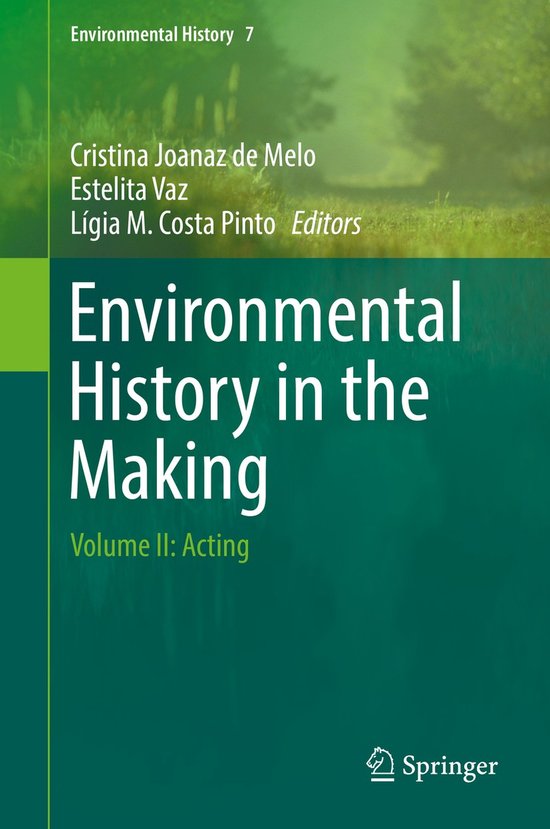
This book is the product of the 2nd World Conference on Environmental History, held in Guimarães, Portugal, in 2014. It gathers works by authors from the five continents, addressing concerns raised by past events so as to provide information to help manage the present and the future. It reveals how our cultural background and examples of past territorial intervention can help to combat political and cultural limitations through the common language of environmental benefits without disguising harmful past human interventions.
Considering that political ideologies such as socialism and capitalism, as well as religion, fail to offer global paradigms for common ground, an environmentally positive discourse instead of an ecological determinism might serve as an umbrella common language to overcome blocking factors, real or invented, and avoid repeating ecological loss.
Therefore, agency, environmental speech and historical research are urgently needed in order tosustain environmental paradigms and overcome political, cultural an economic interests in the public arena.
This book intertwines reflections on our bonds with landscapes, processes of natural and scientific transfer across the globe, the changing of ecosystems, the way in which scientific knowledge has historically both accelerated destruction and allowed a better distribution of vital resources or as it, in today’s world, can offer alternatives that avoid harming those same vital natural resources: water, soil and air. In addition, it shows the relevance of cultural factors both in the taming of nature in favor of human comfort and in the role of the environment matters in the forging of cultural identities, which cannot be detached from technical intervention in the world.
In short, the book firstly studies the past, approaching it as a data set of how the environment has shaped culture, secondly seeks to understand the present, and thirdly assesses future perspectives: what to keep, what to change, and what to dream anew, considering that conventional solutions have not sufficed to protect life on our planet.
- Langue
- en
- Version
- Couverture rigide
- Date de sortie initiale
- 01 novembre 2016
- Nombre de pages
- 376
- Illustrations
- Avec illustrations
Personnes impliquées
- Auteur principal
-
Cristina Joanaz de Melo
- Deuxième auteur
-
Estelita Vaz
- Rédacteur en chef
-
Cristina Joanaz de Melo
- Deuxième rédacteur
-
Estelita Vaz
- Editeur principal
-
Springer International Publishing Ag
Informations sur le fabricant
- Nom du fabricant
- Springer Nature Customer Service Center GmbH
- Adresse du fabricant
- Europaplatz 3 | 69115| Heidelberg| DE
- Adresse électronique du fabricant
- [email protected]
- Informations sur le fabricant
- Les informations du fabricant ne sont actuellement pas disponibles
Autres spécifications
- Hauteur de l’emballage
- 235 mm
- Largeur d’emballage
- 155 mm
- Largeur du produit
- 155 mm
- Livre d‘étude
- Oui
- Longueur d’emballage
- 235 mm
- Longueur du produit
- 235 mm
- Poids de l’emballage
- 7096 g
- Police de caractères extra large
- Non
- Édition
- 1st ed. 2017
EAN
- EAN
- 9783319411378
Sécurité des produits
- Opérateur économique responsable dans l’UE
-
Afficher les données
Vous trouverez cet article :
- Catégories
-
Hommes et société
Science et nature
Religion, spiritualité et philosophie
Sociologie
Philosophie
Terre et environnement
Biologie
Philosophie sociale et politique
Environnement
Sciences de la vie
Livres
- Livre, ebook ou livre audio ?
-
Livre
- Disponibilité
-
Disponible à l’adresse suivante
- Langue
-
Anglais
- Type de livre
-
Hardcover





Avis
Il n’y a pas encore d’avis.