
Description
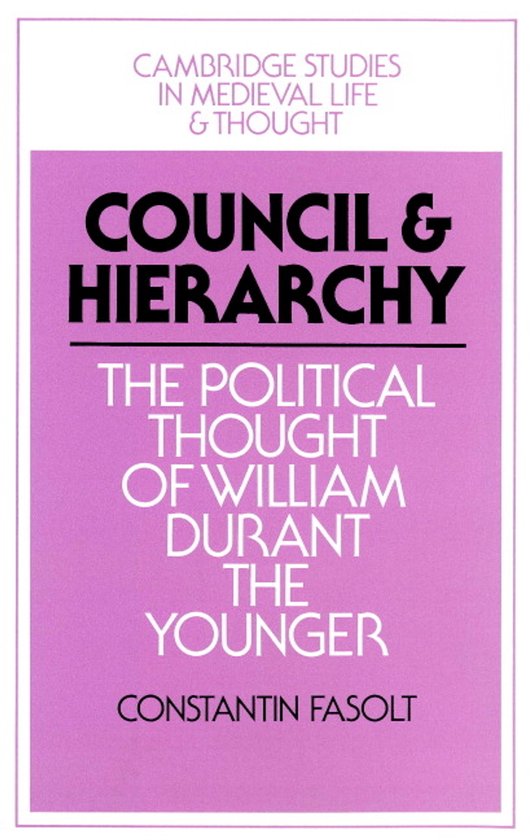
This is a systematic interpretation of William Durant’s project to transfer supreme legislative authority from the papacy to general councils. It suggests that the conciliar theory has a more ambivalent complexion than is sometimes recognized. In 1311, at the council of Vienne, William Durant the Younger (c. 1266–1330), the French bishop and count, demanded that general councils ought to meet every ten years in order to place effective limits on the papal plenitude of power because ‘what touches all must be approved by all’. This is the first systematic interpretation of William Durant’s remarkable project to transfer supreme legislative authority from the papacy to general councils. It suggests that the conciliar theory has a more ambivalent complexion than is sometimes recognized. It confirms, on the one hand, that constitutional ideas were deeply embedded in the tradition of the church, which enabled Durant to anticipate the council of Constance by more than a hundred years. On the other hand, Durant attributed an authority to ancient law that overrode his republican ideas, sapped their vitality, and launched him on a pursuit of the true meaning of the law that could end only in his transformation into an historian and a reluctant champion of monarchy. William Durant the Younger’s ideas thus help us to understand both the origins of the conciliar theory and the transition from late medieval reform movements to early modern humanism and princely sovereignty. LangueenVersionBrochéDate de sortie initiale09 mai 2002Nombre de pages440IllustrationsNon
Personnes impliquées
Auteur principal
Constantin Fasolt
Deuxième auteur
Rosamond Mckitterick
Rédacteur en chef
Rosamond Mckitterick
Deuxième rédacteur
Christine Carpenter
Editeur principal
Cambridge University Press
Informations sur le fabricant
Nom du fabricantMare Nostrum Group B.V.Adresse électronique du fabricant[email protected]Informations sur le fabricantLes autres informations du fabricant ne sont actuellement pas disponibles
Autres spécifications
Hauteur de l’emballage27 mmHauteur du produit27 mmLargeur d’emballage139 mmLargeur du produit139 mmLivre d‘étudeOuiLongueur d’emballage217 mmLongueur du produit217 mmPoids de l’emballage600 gPolice de caractères extra largeNonÉditionNew edition
EAN
EAN9780521894081
Sécurité des produits
Opérateur économique responsable dans l’UE
Afficher les données
Vous trouverez cet article :
Catégories
Hommes et société
Religion, spiritualité et philosophie
Histoire
Politique
Religion
Europe
Science politique et Théorie
Christianisme
Régions et pays
Livres
Livre, ebook ou livre audio ?
Livre
Disponibilité
Disponible à l’adresse suivante
Langue
Anglais
Sujet
Christendom




Avis
Il n’y a pas encore d’avis.