
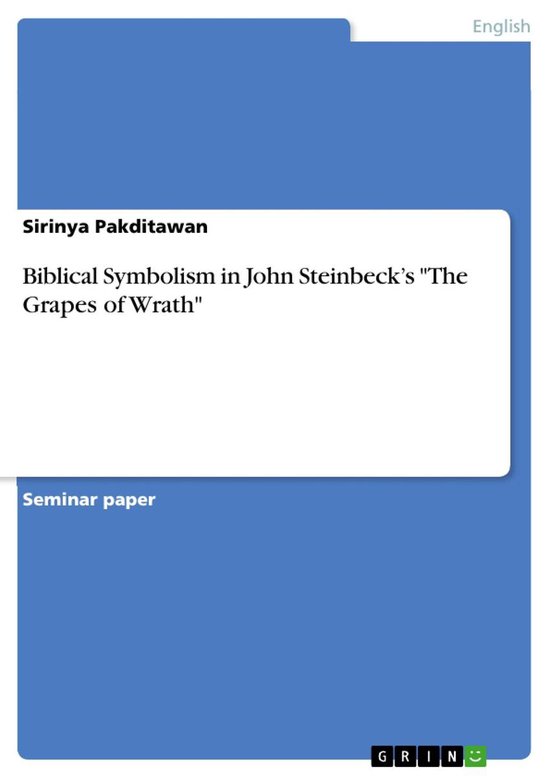
Description
Seminar paper from the year 2011 in the subject American Studies – Literature, grade: 1,2, , language: English, abstract: In 1938 John Steinbeck began writing The Grapes of Wrath, a novel which was to gain him his greatest acclaim. This novel is set in the time of the Great Depression and of the Dust Bowl in America. In The Grapes of Wrath Steinbeck tries to expose the hardships and plights of the people dispossessed from their lands during that time. People like the Joads from Oklahoma that were to become exploited migrant workers in California, a place which they thought the Promised Land. Hence, Steinbeck gained the reputation of being a “proletarian writer” because he sides with the common worker. Thus, The Grapes of Wrath also belongs to Steinbeck’s Labor Trilogy. What is more, his novel was sharply criticized and very much discussed at the time of its publication: “It was publicly banned and burned by citizens, it was debated on national radio hook-ups; but above all, it was read”. In spite of all this critique, in 1940 Steinbeck was awarded the Pulitzer Prize for this novel and in 1962 he also won the Noble Prize for Literature. Hence, the Grapes of Wrath must be more than simply a piece of propagandistic writing. In point of fact, “Steinbeck patterned the book on far more universal themes, both the biblical story of Exodus, and also humanity’s capacity for survival (…) in the face of (…) calamity”. It is very interesting that Steinbeck uses biblical parallels in his story. Thus, he alludes to the Old Testament, the Israelites and the Exodus as well as to Christ and the New Testament. In other words, one might also say that Steinbeck takes the reader through the development of the Bible in order to reveal the migrants’ developing humanity and religion. This is already suggested by the title of this novel for it is taken from The Battle Hymn of the Republic by Julia Ward Howe. The fact that Steinbeck’s great American novel seems to rely firmly on a biblical consciousness is suggested in this context because the lyrics of the Battle Hymn also refer to the biblical passage Revelation. This passage appeals to deliverance in the final judgement. Hence, as far as the novel is concerned, it is suggested that there will also be deliverance of the workers after managing all their hardships and developing compassion and humanity.
LangueenVersionlivre numériqueDate de sortie initiale17 novembre 2014Format ebookAdobe ePubIllustrationsNon
Personnes impliquées
Auteur principal
Sirinya Pakditawan
Editeur principal
Grin Verlag
Options de lecture
Lisez cet ebook surLecteur électronique KoboAndroid (smartphone et tablette)Ordinateur de bureau (Mac et Windows)iOS (smartphone et tablette)Windows (smartphone et tablette)
Informations sur le fabricant
Informations sur le fabricantLes informations du fabricant ne sont actuellement pas disponibles
Autres spécifications
Livre d‘étudeNonPornoNonÉdition1
EAN
EAN9783656841197
Sécurité des produits
Opérateur économique responsable dans l’UE
Afficher les données
Vous trouverez cet article :
Catégories
Langue
Poésie, anthologies et littérature
Anthologies littéraires
Linguistique
Livres
Livre, ebook ou livre audio ?
Ebook
Disponibilité
Disponible à l’adresse suivante
Langue
Anglais
Toegankelijkheidsinformatie
Bevat toegankelijkheidskenmerken



Avis
Il n’y a pas encore d’avis.